

2026 Nobel Prize Lectures at National Chung Cheng University
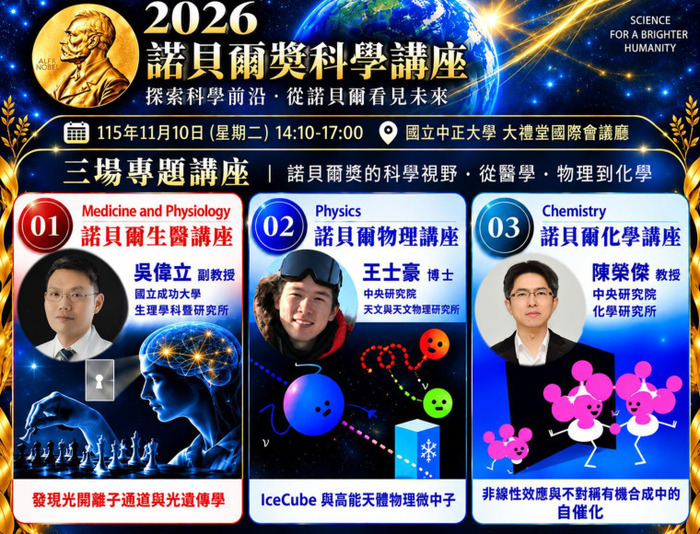
The 2026 Nobel Prize laureates were announced in early October. Following tradition, the Center for Science Education in the College of Science at National Chung Cheng University (CCU) hosted the "2026 Nobel Prize Science Lectures" on campus. Leading experts from Taiwan provided in-depth analyses of the groundbreaking scientific achievements recognized in this year’s Nobel Prizes in Physiology or Medicine, Physics, and Chemistry. The event aimed to strengthen science education and talent cultivation both at CCU and among local high school students.
This year’s Nobel Prize in Physiology or Medicine was awarded to Karl Deisseroth (USA), Peter Hegemann (Germany), and Georg Nagel (Germany) "for their groundbreaking discoveries in the mechanisms of light-gated ion channels and optogenetics." The brain and nervous system represent evolution’s most complex masterpiece, regulating all vital activities of an organism, including perception, thought, emotion, and behavior. Without functioning neural signal transmission, we would be unable to perceive the external world or respond to our environment. However, the brain is composed of tens of billions of intricately intertwined neurons, and for a long time, scientists found it difficult to precisely switch on, off, and regulate nerve cells in specific regions without disrupting the vast network. By combining light-sensitive ion channel proteins with genetic engineering techniques, optogenetics enabled researchers to precisely control specific neural circuits using light.
The Nobel Prize in Physics was awarded to Francis Halzen (USA) "for decisive contributions to the IceCube Neutrino Observatory and the discovery of high-energy neutrinos of astrophysical origin." Although neutrinos—these highly mysterious "ghost particles"—and their underlying theory were proposed in the early to mid-20th century, high-energy neutrinos from the deep cosmos remained virtually undetectable through traditional observations due to their extremely weak interaction with ordinary matter. However, Halzen spearheaded the development and construction of the massive IceCube Neutrino Observatory, buried deep beneath the Antarctic ice sheet, successfully detecting and pinpointing high-energy cosmic neutrinos from violent astrophysical phenomena for the first time experimentally. This discovery carries profound significance in fundamental science: it breaks through the limitations of traditional electromagnetic astronomy, opens a new era of high-energy neutrino astronomy, and opens up new directions for today’s rapidly evolving field of multimessenger astronomy and the exploration of cosmic extremes.
The Nobel Prize in Chemistry went to two scientists, Henri B. Kagan (France) and Kenso Soai (Japan), in recognition of their outstanding contributions to "groundbreaking discoveries concerning non-linear effects and autocatalysis in asymmetric organic synthesis." Asymmetric synthesis refers to chemical reactions that selectively generate a single optical isomer. The two laureates discovered the remarkable phenomena of "non-linear effects" and "asymmetric autocatalysis," which can self-replicate and dramatically amplify minute initial asymmetries in starting materials to extraordinarily high purity. This mechanism holds immense conceptual and practical value: it not only provides a pivotal chemical explanation for unlocking the centuries-old mystery behind the "origin of homochirality" in biological molecules, but also plays a vital role across several key domains—including guiding the design of high-performance chiral catalysts, enhancing the purity and safety of pharmaceutical development and manufacturing, and driving innovative advances in fine organic synthesis.
Professor Wei-Ping Hu, Director of the Center for Science Education, emphasized that CCU had organized the Nobel Prize Science Lectures for ten consecutive years, inviting high school teachers and students from neighboring areas to participate each year. For the 2026 edition, three distinguished speakers were invited to present the laureates’ groundbreaking work: Professor Wei-Li Wu (Department of Physiology, National Cheng Kung University), Professor Shih-Hao Wang (Institute of Astronomy and Astrophysics, Academia Sinica), and Professor Rong-Jie Chein (Institute of Chemistry, Academia Sinica).
Held on Tuesday, November 10, 2026, at 2:00 p.m. in the International Conference Hall of CCU’s Auditorium, the 2026 Nobel Prize Science Lectures offered attendees an opportunity to explore the world’s most prestigious scientific achievements and the inspiring stories of the laureates. The event was open to all students, educators, and members of the public, and was also livestreamed for those unable to attend in person at https://www.youtube.com/watch?v=kDjP0yDzn4s.