

CCU’s Indigenous Student Resource Center and Office of International Affairs Partnered with the Chiayi Post Office to Promote Financial Literacy and Fraud Prevention on Campus
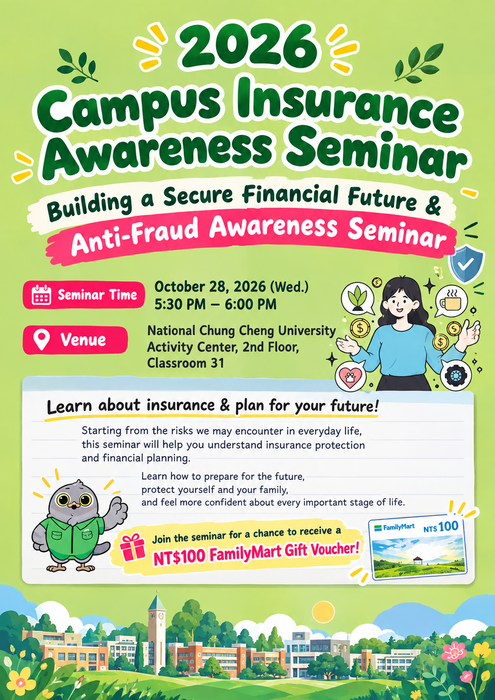
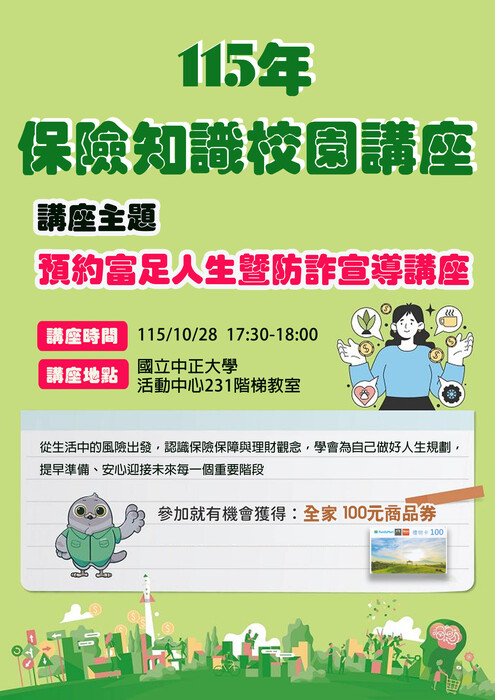
To enhance young people’s financial literacy and awareness of fraud prevention, the Indigenous Student Resource Center and the Office of International Affairs at National Chung Cheng University (CCU) partnered with the Chiayi Post Office of Chunghwa Post Co., Ltd. to host the campus lecture, "Planning for a Prosperous Future and Fraud Prevention: Insurance and Financial Literacy," on October 28, 2026, at 5:30 p.m. The event took place in Lecture Hall 231 at the CCU Student Activity Center and welcomed Indigenous students, international students, and the broader student community. Through cross-sector collaboration, the organizers brought practical knowledge of insurance, financial planning, and fraud prevention to campus, helping students from diverse cultural backgrounds develop sound financial habits and a stronger understanding of financial risk management.
The event attracted a total of 37 faculty members and students. International and Indigenous students together accounted for nearly 80 percent of all registrants, highlighting the importance of promoting financial education across cultures and reflecting students’ strong interest in investment planning and learning how to recognize potential scams. Amid increasingly diverse financial information and ever-evolving fraud schemes, knowing how to manage personal finances, identify unrealistic investment promises, and avoid financial scams has become an essential life skill for young people.
To accommodate the language needs of international students, the Indigenous Student Resource Center arranged for an Indigenous student with foreign language proficiency to provide on-site interpretation during the event. This support helped international students better understand the financial planning concepts and fraud prevention information presented in the lecture, enabling participants from diverse linguistic and cultural backgrounds to engage more fully in the learning experience. The arrangement also demonstrated the Indigenous Student Resource Center’s commitment to addressing the needs of students from diverse backgrounds while fostering cross-cultural exchange, peer support, and a more inclusive campus learning environment.
The lecture introduced postal life insurance as a starting point for understanding insurance protection, financial planning, and risk management. Through practical case studies and interactive question-and-answer sessions, participants learned about common fraud tactics and were reminded to remain vigilant when evaluating investment opportunities. Students were cautioned against misleading investment claims promising high returns with little risk. They were also advised never to allow others to use their bank accounts or assist with suspicious financial transactions, as such actions could result in their being exploited by fraud syndicates or even facing criminal liability. Interactive quizzes and prizes further encouraged participation and helped reinforce key financial literacy and fraud prevention concepts in an engaging learning environment.
Ms. Yue-Zhen Wang, Director of the Chiayi Post Office, emphasized that students were at a crucial stage in developing financial knowledge and risk awareness. She noted that providing practical education on insurance, financial planning, and fraud prevention through campus lectures could help students manage their money responsibly, assess investment risks carefully, and improve their ability to recognize scams. She added that the Chiayi Post Office would continue to fulfill its social responsibility as a financial services provider by promoting financial literacy and fraud prevention to safeguard the public’s financial security.
The Indigenous Student Resource Center stated that this collaboration with the Chiayi Post Office and the Office of International Affairs integrated financial education and fraud prevention into student support services, addressing the learning needs of students from diverse backgrounds, including their adjustment to life in Taiwan and their need for practical financial knowledge. The enthusiastic participation of international students particularly underscored the importance of financial planning and fraud prevention education for students studying in Taiwan. By arranging for an Indigenous student with foreign language proficiency to provide interpretation, the Indigenous Student Resource Center also encouraged mutual support among students and promoted cultural exchange and understanding. Looking ahead, the Indigenous Student Resource Center hoped to continue integrating university and community resources to create a diverse, inclusive, and practical learning environment that would help students enhance their financial literacy, strengthen their ability to protect themselves from financial risks, pursue their studies with peace of mind, and plan responsibly for their future.