

From Chung Cheng Campus to National Policy: MOE Tech Director Yeh Chia-Hung Speaks on AI in Education
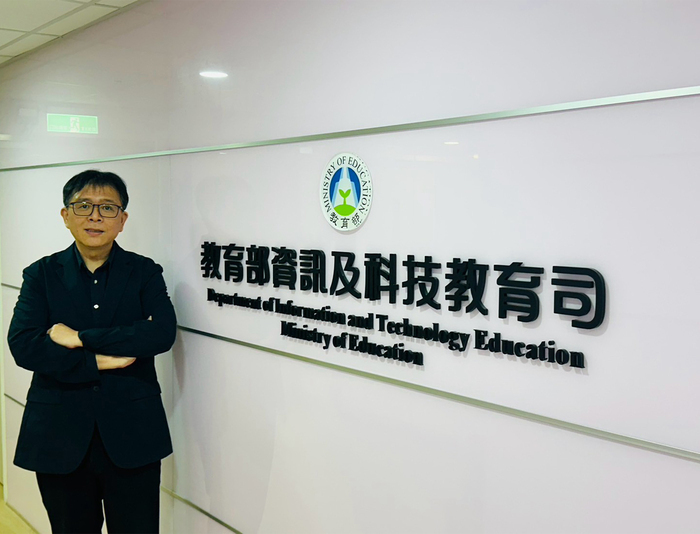
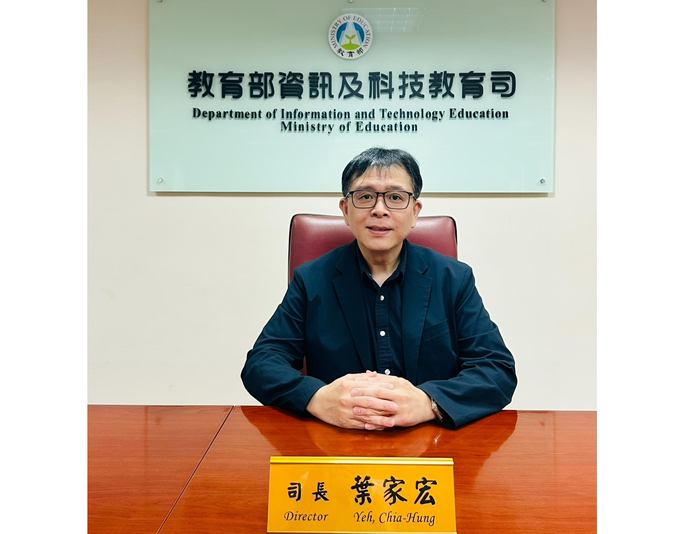
In an era where the surge of artificial intelligence (AI) is sweeping across the globe, educational transformation is often viewed as a race driven by technology. However, in the eyes of Yeh Chia-Hung, Director-General of the Department of Information and Technology Education under the Ministry of Education (MOE), the ultimate concern of this reform was actually the warmth of "people." As an outstanding alumnus of the Department of Electrical Engineering at National Chung Cheng University (CCU), the Director-General recently gave an exclusive interview, warmly recalling the humble and endearing days of CCU's early years. Furthermore, he translated this deep-seated affection for the campus into nourishment for national educational policy, pushing forward the human-centric "AI Talent Ark Project"—which places understanding, care, and companionship at its core—in hopes of building a bridge of digital equity for Taiwan's children and striving to bridge the digital divide in the AI era.
"I was a student in CCU's second graduating class, completing my bachelor's, master's, and doctoral degrees here. Those nine years of student life were truly a vital period of youth in my life," the Director-General recalled with a smile. When he first entered the university, CCU was still in its founding stage, with only two undergraduate dormitories completed, and the campus trees were mere saplings that often stirred up dust storms when the wind blew. Back then, the surrounding area had not yet been developed, and many facilities were still under construction. Occasionally, one could even see ox carts casually passing by the campus perimeter. This traditional, simple lifestyle collided with the academic atmosphere of a newly established university in Chiayi, creating a unique and vibrant picture that became one of the most vivid memories of his student days.
What left an even deeper impression on Director-General Yeh Chia-Hung were the stories behind many of the paths on CCU's campus. "Many of the paved cement paths today were actually lush green lawns back then," he laughed, explaining that for convenience, students gradually trod out "shortest path" shortcuts across the grass over time. Seeing the lawns worn down into small footpaths, the university did not erect fences to prohibit walking. Instead, it paved paths along the exact routes students actually walked, such as the sloping trail between the graduate and undergraduate dormitories. These "paths walked into existence by students" were not only fond memories of campus life, but also made him feel CCU's empathy and thoughtfulness toward student needs.
Looking back on his nine-year academic journey, he expressed the deepest gratitude for the mentors who guided and supported him along the way. "I was very fortunate to meet many exceptional teachers during my studies who not only imparted professional knowledge, but also taught me many principles of conduct and life." Among them, his advisor, Professor Kuo Chung-Jung, had the most profound impact on him. Accompanying him through his academic growth from his undergraduate senior project to master's and Ph.D. studies, Professor Kuo not only provided rigorous research training, but also encouraged him to step out and broaden his international horizons. Upon completing his doctorate, a single sentence from his advisor—"Go abroad and see the world"—prompted his decision to pursue two and a half years of postdoctoral research at the University of Southern California, laying a crucial foundation for his future academic research and interdisciplinary development. Beyond his advisor, he was also inspired and cared for by many department faculty members during his student years. Their instruction in expertise, research, and life attitudes served as essential nourishment for his later endeavors in teaching, research, and public service.
From a university professor to the Secretary-General of the Society for Academic and Industrial Advancement, and later Technology Director at the Service Systems Technology Center of the Industrial Technology Research Institute (ITRI), the Director-General traversed different stages of academic research, industry-academic collaboration, and technological R&D. While accumulating practical technical experience, he gradually expanded his thinking on industrial development and talent cultivation. In academia and industry, he spent years devoting himself to cross-disciplinary technological R&D and innovative applications, starting from real-world needs in different fields to explore how technology could genuinely solve problems and create value. At the Ministry of Education, bearing the vital mission of advancing national educational policy and leading the development of information and technology education, he brought his accumulated expertise in technology, industry, and interdisciplinary fields directly into educational settings. The Director-General's original intention remained unchanged: "Technology is merely an aid; talent cultivation and education are the true core."
The Director-General noted that through the "Digital Learning Enhancement Program for Primary and Secondary Schools," the MOE previously promoted "Internet in Every Class, Tablets for Every Student," progressively perfecting the campus digital learning environment. Facing the rapid development of AI, the focus had to shift from digital learning to AI literacy and talent development, narrowing the "AI gap" among children. To this end, the MOE was driving the "AI Talent Ark Project" to enhance frontline teachers' AI instruction capabilities and cultivate roots in teacher education programs, ensuring that future teachers possess the capability to utilize AI in assisting teaching during their pre-service stage.