

CCU UAV Team Ranked No. 1 at National Competition, Showcasing Cross-Disciplinary R&D Capability
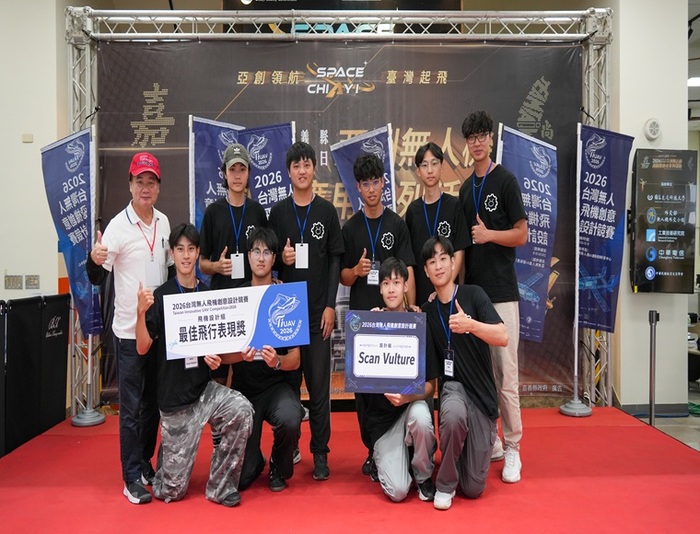
From aerodynamic design, manufacturing, and system integration to actual flight, students from National Chung Cheng University (CCU) successfully built their own Unmanned Aerial Vehicle (UAV) from scratch in less than four months, proudly taking the championship in a national competition. On August 9, 2026, the CCU UAV Team participated in the "2026 Taiwan UAV Design Competition" held at the Asia UAV AI Innovation Application R&D Center in Chiayi County. With their self-developed fixed-wing UAV, "Scan Vulture," the team stood out among competitors, winning both First Place in Aircraft Design and the Best Flight Performance Award. Under the visionary leadership of CCU President Shaw-Jenq Tsai, this remarkable achievement highlighted CCU's cross-disciplinary R&D capabilities in UAV design, electromechanical integration, flight control, and engineering practice.
From Scratch to Flight in Four Months: System Integration Capabilities Recognized
The "Taiwan UAV Design Competition" focused on autonomous UAV development capabilities. Every aspect—from aerodynamic profile and structural strength to electromechanical systems and practical flight performance—rigorously tested each team's comprehensive system engineering and hands-on skills.
The award-winning "Scan Vulture" was designed, manufactured, tested, and integrated with a payload system by the CCU team in under four months. Navigating multiple competition constraints regarding fuselage weight, wingspan, power, and flight modes, the team opted for a highly challenging pusher-propeller fixed-wing configuration. This required repetitive verification and calibration of the aircraft's layout, propulsion efficiency, and flight stability, perfectly demonstrating the students' exceptional mechanical design, manufacturing, and system integration proficiency.
This year's competition was divided into three major stages: oral presentation, static aircraft evaluation, and flight demonstration. The flight competition comprehensively tested the aircraft's wind resistance, maneuverability, takeoff/landing performance, and payload capacity through tasks ranging from empty-weight traffic pattern flights and figure-eight flights to heavy-lift missions. The CCU team not only completed each flight challenge successfully but also earned the judges' high praise for their stable aircraft performance and overall design, ultimately securing First Place in Aircraft Design and the Best Flight Performance Award.
Beyond Flying: Executing Missions and Creating Practical Systems
A newly introduced "Smart Mission" category this year required teams to independently plan their mission content and systems within a strict budget of NT$5,000. Centered on "ground building data collection," the CCU team integrated a controllable gimbal and camera into the aircraft's belly to capture real-time images and collect data during flight.
For the team, a UAV was not merely a flying machine but a smart carrier system capable of executing real-world missions. Students meticulously coordinated flight stability, payload configuration, image acquisition, and mission requirements, transitioning their competition entry from merely "capable of flying" to "ready for practical use."
The flight and mission data accumulated during this event were integrated into the CCU UAV team's database. This will serve as a crucial foundation for future airframe optimization, flight control adjustments, and smart mission development, ensuring that the results of every competition and test are translated into R&D energy for the next stage.
Cross-Disciplinary Integration and Industry Mentorship: Cultivating UAV Talent
Behind these awards lay CCU's long-standing emphasis on cross-disciplinary integration and practice-oriented talent cultivation. UAV R&D could not be accomplished through a single profession; it required close collaboration across various fields, including mechanical structures, aerodynamics, electronic control, communications, information technology, and smart applications.
Professor Shyh-Leh Chen, Distinguished Professor and Dean of R&D at CCU, stated: "Under the guidance of university faculty and industry experts, these students invested a massive amount of time in hands-on practice and testing. Winning these two major awards is the best recognition of the team's long-term efforts and technological accumulation."
To strengthen students' UAV R&D capabilities, CCU actively recruited industry experts with practical experience to bring industrial system engineering perspectives onto the campus. From design evaluation and testing verification to troubleshooting, students learned not only "how to build an airplane" but also how to tackle real engineering problems, utilizing data, testing, and continuous refinement to find solutions.
This cultivation model allowed students to directly apply classroom knowledge in mechanics, control, and engineering to physical carrier development. By accumulating problem-analysis, teamwork, system-integration, and engineering-verification skills in real scenarios, CCU effectively bridged the gap between academic education and industry needs.
Anchored in the Chiayi UAV Cluster: CCU Connects Mechanical, IT, and Communication R&D
As Chiayi rapidly developed into Taiwan's vital UAV R&D and industrial cluster, CCU leveraged its geographical and cross-disciplinary research advantages to actively engage in UAV-related technology and talent cultivation.
In recent years, CCU continuously integrated internal research energy across mechanical engineering, computer science, electrical communications, and smart technology. From carrier structures, flight control, and communication transmission to AI applications, the university steadily built a cross-disciplinary UAV R&D system. Through competitions, research, industry-academia collaboration, and practical training, CCU equipped students with the ability to transform theoretical knowledge into implementable technologies.
The dual recognition of "Scan Vulture" in design and flight performance at this national competition was more than just a victory; it was a testament to CCU's comprehensive R&D energy, spanning from talent cultivation and cross-disciplinary integration to physical aircraft verification.
Facing Taiwan's proactive development of its UAV supply chain and autonomous technologies, CCU will continue to deepen its research in unmanned carriers, smart control, and cross-disciplinary system integration. By capitalizing on the advantages of the Chiayi UAV industrial cluster, the university aims to strengthen the connection between academia and the industrial supply chain, cultivating more UAV R&D talents with practical and innovative capabilities, and injecting new momentum into Taiwan's UAV industry and the autonomy of key technologies.