

CCU Distinguished Professor Assumes Vice-Chairmanship of Healthcare System Consortium; International Representatives Witness the Inauguration
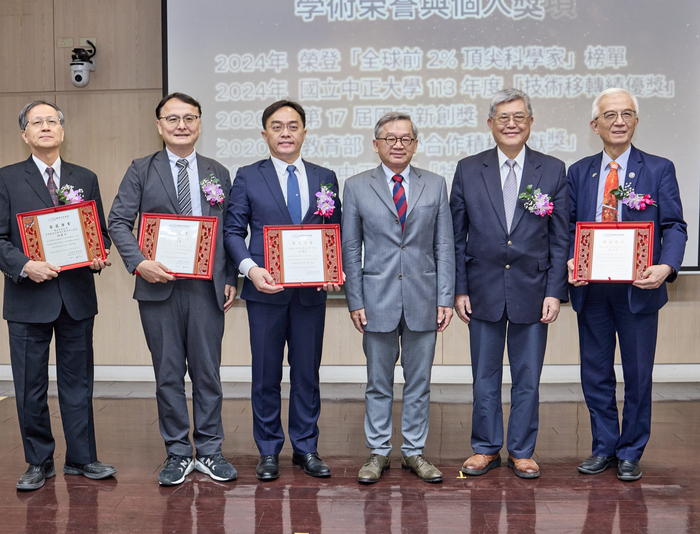
The Healthcare System Consortium (HSC) held its third inauguration ceremony for the board chairperson at Tunghai University. Under the supervision of Minister Wu Cheng-Wen of the National Science and Technology Council (NSTC), Weng Shao-Jen, a professor in the Department of Industrial Engineering and Enterprise Information and Dean of the College of Interdisciplinary Innovation at Tunghai University, officially took office as the third chairperson, while Yao Her-Terng, a Distinguished Professor in the Department of Mechanical Engineering at National Chung Cheng University (CCU), assumed the position of vice-chairperson.
Newly appointed Vice-Chairperson Yao Her-Terng stated that the Advanced Institute of Manufacturing with High-Tech Innovations (AIM-HI) at CCU was honored to join the HSC. The center integrated technologies such as medical imaging AI analysis, smart manufacturing, and 3D printing into the digital healthcare field, while assisting the consortium in promoting cooperation with large medical institutions in southern Taiwan, such as Chiayi Christian Hospital and Kaohsiung Chang Gung Memorial Hospital.
The event attracted representatives from multiple countries, including David Steinke, Representative of the Czech Economic and Cultural Office in Taipei, and Lucia Langer, Representative of the Slovak Economic and Cultural Office in Taipei. The Czech representative pointed out that Taiwan possessed comprehensive energy for integrating medical and technological advancements and expressed hope that the HSC platform would reduce the risks of introducing innovative products into the European market.
NSTC Minister Wu Cheng-Wen remarked that he traveled to Taichung because the "Healthcare System Consortium" originated from a small industry-academia alliance project supported by the NSTC at Tunghai University in 2017. In just a few years, the project flourished from a small-scale collaboration into a large-scale interdisciplinary alliance spanning academia, industry (including machinery, smart manufacturing, medical devices, and biotechnology), and medical systems, transforming into a national—and even internationally linked—consortium, which was truly admirable.
Wu emphasized that future development was destined to move toward a "Big Health" industry. Therefore, in addition to the NSTC, the Ministry of Health and Welfare, and the Ministry of Economic Affairs, resources from cross-ministerial departments—including the Ministry of Culture, the Ministry of Sports, the Ministry of Digital Affairs, the Ministry of the Interior, the Ministry of Transportation and Communications, the Ministry of Agriculture, and the Ministry of Environment—needed to be integrated to comprehensively care for the physical and mental health of the public and to create a larger-scale "Big Health" industrial ecosystem.
Tunghai University Vice President Liu Cheng noted that the HSC had become a vital bridge between Taiwan's medical industry and academic research. Newly appointed Chairperson Weng Shao-Jen stated that the HSC accumulated over 100 industry-academia cooperation projects over the past decade, assisting hospitals in optimizing emergency department workflows, surgical scheduling, and medical resource allocation. It had also received the Gold and Silver Awards of the 2023 and 2024 Asia-Pacific and Taiwan Sustainable Action Awards (SDGs). He emphasized that the consortium would continue to strengthen international connections, having already established exchange mechanisms with 14 countries, including the United States, the Czech Republic, and Palau.