

Zhuluo Studies Symposium Opened at CCU; College of Liberal Arts Launched Religious Artifacts Exhibition Showcasing Faith through Art and Cultural Heritage
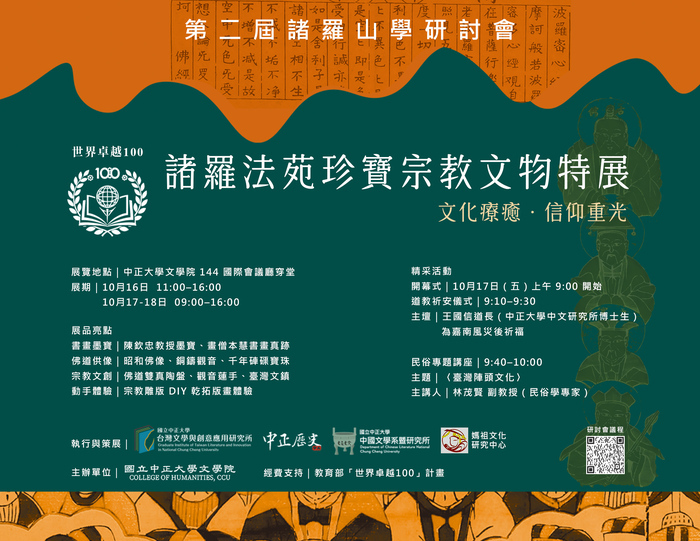
The Second Zhuluo Studies Symposium, hosted by the College of Liberal Arts at National Chung Cheng University (CCU), was held on October 17–18, 2025, on the CCU campus in Chiayi. The symposium highlighted key themes such as forestry development, religious art, local literature, and traditional performing arts in the Chiayi region. Over twenty scholars from across Taiwan were invited to present and discuss topics related to local knowledge, historical memory, and cultural practice.
In conjunction with the symposium, the “Treasures from the Dharma Garden of Zhuluo” Religious Artifacts Exhibition, curated by Professor Chuan-Cheng Su, Director of the Mazu Culture Research Center at CCU, was held from October 16 to 18 in the atrium outside Room 144 of the College of Liberal Arts. The exhibition was themed “Cultural Healing, Renewed Faith,” offering spiritual solace and renewal in the wake of recent floods through the power and beauty of religious art.
Calligraphy and Rubbings Exhibits
Exhibits included blessing calligraphy scrolls created by Taiwan’s first Ph.D. in calligraphy, Professor Chin-Chung Chen, for the Mazu Culture Research Center, and original ink paintings by Buddhist master Ben-Hui, showcasing profound religious artistry and spiritual depth. Also on display was a rare vermilion-rubbing replica of an 1821 stele from the Chiayi Dizang Temple, providing valuable visual documentation for the study of temple history and folk belief in Taiwan.
Paintings of Temples and Deities
Among the Western-style artworks were early oil paintings by Chi-Tung Yang depicting Changhua's Nanyao Temple, and a powerful image of Zhong Kui painted in vermilion by Professor Chi-Tao Wu, symbolizing protection and exorcism in folk religion. The exhibition also featured a painting of Maitreya Bodhisattva by Japanese monk Houkyu, along with 1950s-era Taoist hanging scrolls—hand-painted or printed—illustrating diverse visual languages of religious art across time and cultures.
Buddhist and Taoist Statuary
The statuary section showcased exquisitely crafted Buddhist and Taoist icons, including a bronze Shakyamuni head, Water-Moon Avalokitesvara, sandalwood Buddha sculptures, and a bronze medallion of Tendo Nyorai cast in 1933. Particularly rare were the fossilized giant clamshells (Tridacna gigas) and Tridacna pearls, considered one of the Seven Buddhist Treasures, representing both religious symbolism and natural rarity.
Ceramic Art and Cultural Innovation
The exhibition also featured religious-themed ceramic art by artist Shu-Yao Chang, based on concepts by Professor Chuan-Cheng Su. Pieces included limited-edition Buddhist-Taoist twin plates, Guanyin figurines, lotus Buddha hands, Taiwan island-shaped paperweights, and Buddhist prayer bead bracelets, all created using the extrusion method and rich in symbolism. Visitors also tried their hand at traditional woodblock printing in an interactive rubbing station, recreating sacred images through hands-on experience.
Opening Ceremony: Taoist Blessing Ritual and Folk Culture Lecture
The symposium officially opened at 9:00 a.m. on October 17, followed by a Taoist blessing ritual led by Taoist priest Kuo-Hsin Wang, a Ph.D. student from CCU’s Department of Chinese Literature, offering prayers for the Chiayi region and the university campus. At 9:40 a.m., renowned folklore scholar Professor Mao-Hsien Lin delivered a keynote speech titled “Taiwan’s Parade and Performance Culture,” delving into the evolution and contemporary significance of temple processions, ritual practices, and folk performance troupes.
Local Knowledge as Root, Global Vision as Aim
The Zhuluo Studies Initiative represented CCU’s commitment to interdisciplinary scholarship, integrating Taiwanese literature, history, religion, and local cultural heritage. Dean Wen-Fang Mao of the College of Liberal Arts highlighted the college’s recent achievement in ranking 31st globally in the QS World University Rankings for Classics & Ancient History, second in Taiwan only to NTU. This recognition, alongside support from the Ministry of Education’s World Top 100 Humanities Excellence Program, demonstrated CCU’s growing global academic presence and dedication to humanities research.