

Research on Electromagnetic Waves and Renewable Energy Yields Fruitful Results: Two Professors from National Chung Cheng University Receive Outstanding Research Awards from National Science Council
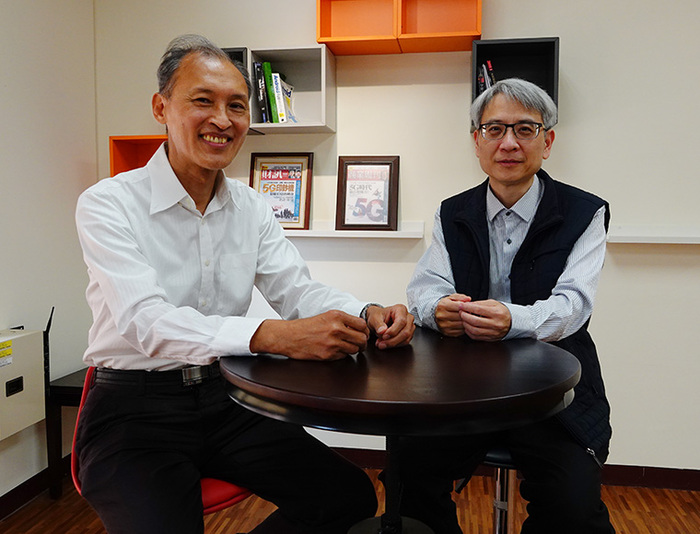
The National Science and Technology Council (NSTC) recently announced the winners of the 111th Outstanding Research Awards and two professors from National Chung Cheng University (CCU) were among the awardees. Professor Sheng-fuh Chang from the Department of Communications Engineering and Electrical Engineering, and Yuan-Kang Wu from the Department of Electrical Engineering were both recognized for their outstanding research achievements. Prof. Chang specializes in electromagnetics and has also applied his expertise to biomedical detection and positioning technology. In recent years, he has been working on Reconfigurable Intelligent Surfaces technology (RIS) that has the potential to stabilize the electromagnetic environment, enabling communication to expand its reach without being affected by blind spots. Prof. Wu, on the other hand, focuses mainly on the analysis of power systems related to renewable energy integration, including prediction, dispatching, and control techniques; he has not only collaborated on numerous interdisciplinary research projects, but has also kept up with the international trends in energy development.
Looking back to when I first entered the Department of Electrical Engineering at CCU and established the Wireless Communication Lab, Professor Sheng-fuh Chang said, "We conducted various research, from Radio Frequency (RF) components, transceiver templates to microwave integrated circuits, until 2005 when we began to integrate electromagnetic systems hardware and software and ventured into the field of biomedicine. We applied electromagnetic waves to physiological measurements, which allowed us to detect vocal cord vibrations during speech and also sense respiratory and cardiac signals, just like a remote pulse-taking. In addition, we also developed a positioning technology in minimally invasive spine surgery, which took us four years to research and overcame the patent restrictions of major biomedical equipment manufacturers worldwide."
"Starting from learning electromagnetics in my sophomore year, to now relying on electromagnetics for a living, it has been 44 years," said Sheng-fuh Chang. At first, he only saw mathematical symbols dancing around without knowing where to begin. Gradually, he began to hear the melodies hidden within the symbols and, figuratively speaking, was even able to soar alongside electromagnetic waves. He expressed gratitude to all his mentors, parents, classmates, peers, who have taught, encouraged, and supported him throughout this journey. In recent years, Sheng-fuh Chang has led a team to tackle the weakness of electromagnetic waves, which can be affected by various environmental factors such terrain, objects on the ground, and man-made structures. These factors can cause the waves to be blocked, scattered, or weakened, leading to a dead zone where the signals cannot function properly. The team has been working on RIFs technology, which utilizes the reflective, refractive, and diffractive properties of electromagnetic waves to guide them, allowing the waves to bypass obstacles and find new paths, thus reactivating the signals in the dead zone.
The other awardee is Professor Yuan-Kang Wu from the Department of Electrical Engineering. In recent years, he has mainly focused on the theoretical and technical analysis of large-scale renewable energy grid integration. In addition to renewable energy generation forecasting, power system inertia assessment, and wind turbine frequency and voltage control technology, his research also includes planning and grid integration technology of offshore wind farms with high-voltage direct current transmission systems, defense technology and system platform establishment of high-penetration renewable energy systems, equivalent model development of wind turbines and large-scale wind farms, congestion management strategies for power market transmission systems, and research on international renewable energy grid integration standards. Yuan-Kang Wu said that these technologies are in line with the trends of national and international energy development and research, and he also actively participates in international academic organizations and service work, conducting cross-border and cross-disciplinary cooperation in renewable energy grid integration technology.
"Down-to-earth, lifelong learning, and pursuit of truth" is the philosophy that Prof. Yuan-Kang Wu has adhered to for a long time. He is grateful to CCU for providing a good teaching and research environment, which has allowed him to collaborate with students, domestic and foreign experts and scholars to achieve many technical accomplishments for more than 10 years. Prof. Wu also expresses his gratitude for the support of his family on his academic research journey. He believes that this honor of receiving the Outstanding Research Awards not only belongs to himself but also to all the people who have worked hard with him.